So, imagine you're in a crunch, and need to make a quarterly report for your board. Due to nebulous reasons, the only person who is available to do this is an intern with a PhD in statistics, but who started at your company two days ago and doesn't even know how the your office coffee machine turns on.
Due to other nebulous reasons, you have a choice between giving that intern:
- A 500-page manual describing your company's datasets and a computer that only runs
calc.exeand a PostgreSQL terminal, or... - A 20-page intro to your company's PowerBI setup, and a PowerBI account
Realistically, you will give the intern the PowerBI account. Sure, it would still be nice if they had your company's tribal knowledge, but they will more likely succeed with the task and make less errors if they drag and drop measures in PowerBI rather than blindly writing raw SQL.
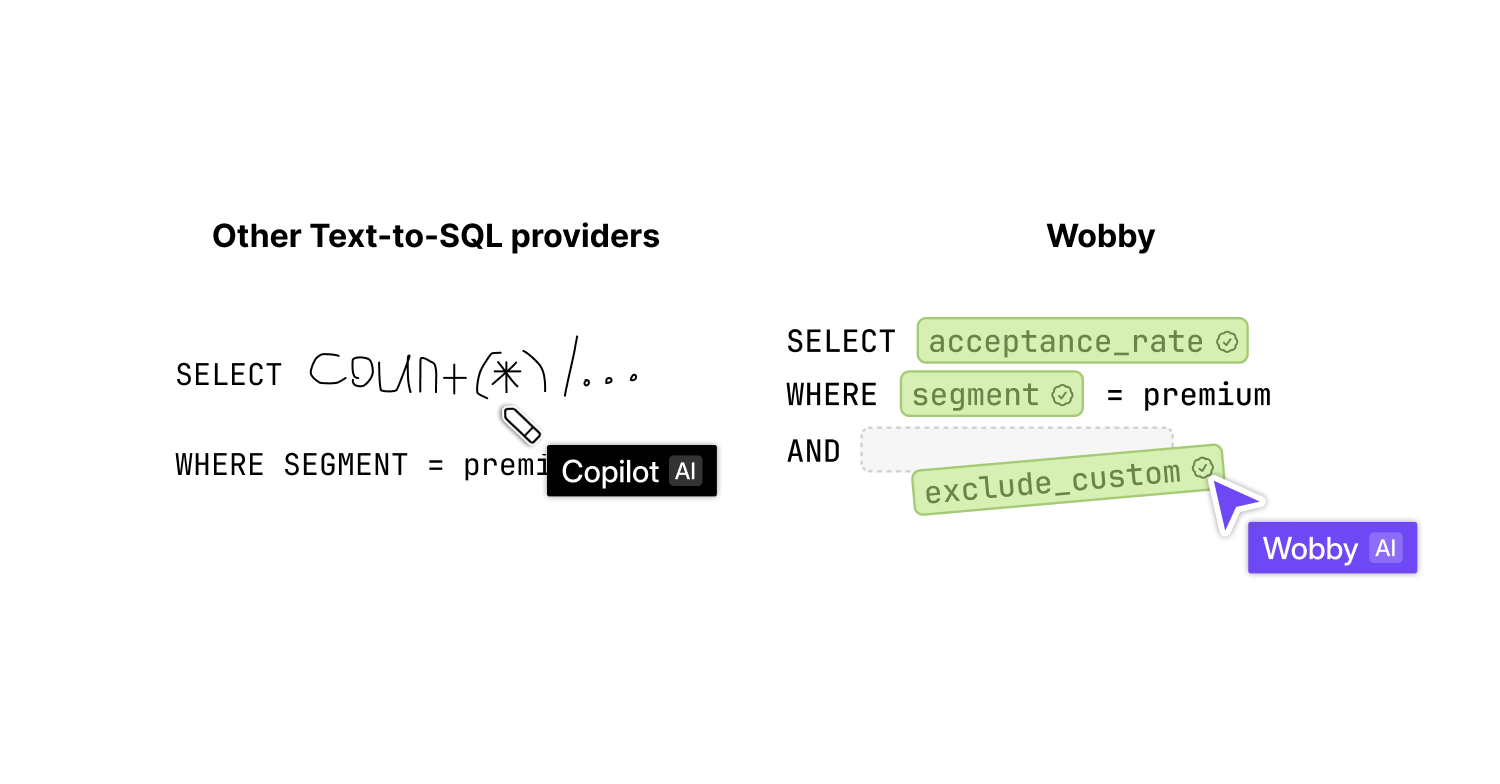
The problem is, most Text-to-SQL solutions are the 500-page manual case — they give the an extremely smart but nil-experience agent a ton of documentation of dubious quality, tell it to do its best, and then whether it does a good job is anyone's guess.
We wanted to change that, so we'd like to introduce the Wobby Semantic Layer, the operating system for agentic BI.
-
Semantic Layer
A translation layer that transforms your raw data from technical abstractions — tables, columns, joins — into business entities that actually mean something: customers, revenue, conversion rates. Instead of agents guessing whattbl_ord_v2.amt_eur_netmeans, they work with "net revenue in euros." -
SemQL
A semantic query language that lets agents query business entities deterministically. No more hallucinated joins. No more invented column names. When an agent asks for "monthly revenue by region," SemQL ensures it gets exactly that — with the exact business logic your team has agreed upon, every single time. -
Steward
The agent that builds your semantic layer for you. Traditional semantic layers are 6-month PoC projects that become outdated documentation the moment they're finished. Steward monitors your team's conversations, detects knowledge gaps, and proposes updates — turning semantic layer maintenance from a burden into an incremental workflow with immediate results.
If you'd like to try it out, you can check out more information in the docs, or reach out to us, and we will help you get set up. Semantic Layer is currently in beta, and we are still ironing over some rough edges, so we'd love to hear what you think about it.
Thanks for reading, and have a great week!